If you are researching double eyelid surgery, the first thing to understand is that a monolid or single eyelid is not a medical problem that needs to be corrected. These are natural variations in eyelid anatomy. Double eyelid surgery is an elective cosmetic procedure that creates or defines an upper eyelid crease for people who …


If you are researching double eyelid surgery, the first thing to understand is that a monolid or single eyelid is not a medical problem that needs to be corrected. These are natural variations in eyelid anatomy. Double eyelid surgery is an elective cosmetic procedure that creates or defines an upper eyelid crease for people who want a different eyelid appearance.
The right approach depends on much more than whether you have a visible crease. Eyelid thickness, skin, fat distribution, existing asymmetry, eyelid movement, eye health, and the type of crease you want all matter. A thoughtful consultation should focus on creating an appearance that fits your facial anatomy rather than simply making the crease as high or as prominent as possible.
For patients considering treatment in Flushing, Queens, NYC, understanding the difference between a double eyelid and a monolid or single eyelid is a useful first step before deciding whether surgery is appropriate.
What Is a Double Eyelid?
A double eyelid refers to an upper eyelid with a visible crease above the lash line when the eye is open. A monolid or single eyelid generally has no clearly visible upper eyelid crease.
The difference is anatomical rather than a question of one eyelid type being better than another. The appearance of the crease is influenced by the relationship between the eyelid skin and underlying structures, including the levator aponeurosis, orbital septum, muscle, and fat.
Some people naturally have a prominent crease. Others have a low or partially hidden crease that becomes more noticeable depending on facial expression, swelling, or other factors.
This is why an eyelid consultation should look at the entire upper eyelid rather than labeling someone simply as having a “single” or “double” eyelid.
Double Eyelid vs Monolid: What Is the Difference?
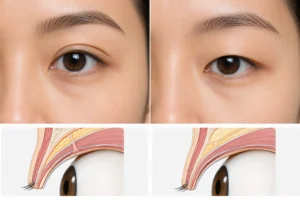
The simplest distinction is the presence or absence of a visible upper eyelid crease.
| Feature | Double Eyelid | Monolid / Single Eyelid |
|---|---|---|
| Visible upper eyelid crease | Usually present | Usually absent or minimally visible |
| Eyelid appearance | Defined fold above the lash line | Smoother upper eyelid contour |
| Eyelid anatomy | Varies considerably between individuals | Varies considerably between individuals |
| Is it medically abnormal? | No | No |
| Surgery required? | No | No |
| Cosmetic surgery option | Can refine or alter an existing crease | Can create an upper eyelid crease |
Neither appearance is inherently healthier or more attractive. The reason someone considers surgery is personal preference, concerns about symmetry, makeup application, or a desire for a particular eyelid contour.
In a consultation, the more useful question is not “Which eyelid is better?” but “What eyelid shape is appropriate for your anatomy and aesthetic goals?”
Double Eyelid vs Single Eyelid: Are They Really Different?
People often search for “double eyelid vs single” and “double eyelid vs single eyelid” as though they describe two completely separate anatomical conditions. In everyday language, these terms are often used interchangeably with double eyelid and monolid.
A single eyelid generally means there is no obvious supratarsal crease. A double eyelid has a visible crease.
There are also intermediate appearances. Someone may have a very low crease, a partially hidden crease, or a crease that becomes visible only under certain conditions. Eyelid anatomy exists on a spectrum rather than in two perfectly defined categories.
That distinction matters when planning surgery. A person with a low crease may need a very different surgical plan from someone with no visible crease and thicker upper eyelid tissue.
Why Do Some People Consider Double Eyelid Surgery?
Patients consider the procedure for different reasons, and the motivation is not always about making the eyes look “bigger.”
Common reasons include:
- Wanting a more defined upper eyelid crease
- Improving perceived eyelid symmetry
- Making eye makeup easier to apply
- Creating a particular eyelid shape
- Addressing a crease that has become less visible
- Refining an existing low or uneven crease
- Seeking a subtle change in overall facial balance
Some people also feel that their eyelids make their eyes appear tired or less defined. That concern needs to be evaluated carefully because hooding, ptosis, excess skin, and a monolid can create somewhat similar visual impressions while having different underlying causes.
Double Eyelid Surgery Is Not Simply About “Making the Eyes Bigger”
This is one of the most important misconceptions to clear up.
Creating an eyelid crease does not automatically mean creating a dramatically larger-looking eye. The appearance after surgery depends on crease position, eyelid anatomy, skin thickness, fat distribution, brow position, eye shape, and how the crease interacts with the existing facial structures.
The goal should therefore be proportion and harmony.
A crease that is unnecessarily high or does not suit the patient’s anatomy can look less natural. During planning, an experienced surgeon considers the patient’s existing features rather than applying exactly the same crease design to everyone.
How Double Eyelid Surgery Works
Double eyelid surgery, sometimes called Asian blepharoplasty in the appropriate clinical context, is designed to create or define an upper eyelid crease.
There are two broad approaches.
Incisional Double Eyelid Surgery
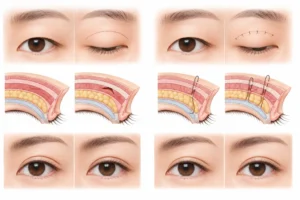
The incisional approach uses an incision along the planned eyelid crease. Depending on the patient’s anatomy, the surgeon can address excess skin or tissue and establish a more stable relationship between the eyelid structures and the skin.
This approach may be considered when someone has:
- Thicker upper eyelid tissue
- More prominent fat
- Excess skin
- A need for more extensive reshaping
- A desire for a more durable crease
The tradeoff is that an incisional procedure generally involves more tissue manipulation and a longer healing process than a less invasive suture technique.
Non-Incisional or Suture Technique
A non-incisional approach uses strategically placed sutures to create the connection that forms the eyelid crease.
It may be appropriate for selected patients with favorable eyelid anatomy and relatively little excess skin or tissue.
Potential advantages include less tissue disruption and a shorter initial recovery. However, the technique is not appropriate for everyone, and the created crease can be less predictable or less durable in some patients.
The choice should be based on anatomy rather than choosing a technique simply because it has a shorter recovery.
What Should Be Evaluated Before Surgery?
A good double eyelid consultation goes beyond looking at photographs.
Before treatment, the surgeon should assess factors such as:
- Existing eyelid crease and its height
- Eyelid symmetry
- Skin thickness
- Amount and distribution of upper eyelid fat
- Eyelid movement and levator function
- Brow position
- Presence of ptosis
- Eye surface health
- Dry-eye symptoms
- Lash direction
- Desired crease style
This evaluation is particularly important because creating a crease can change how the upper eyelid interacts with the ocular surface.
For example, people without a visible crease can sometimes have anatomy that partly protects against ocular surface exposure. If that relationship is altered, dry-eye symptoms may become more noticeable in susceptible individuals. A preoperative eye-health assessment is therefore an important part of responsible planning.
Who May Be a Good Candidate?
There is no single physical feature that makes someone automatically suitable for double eyelid surgery.
A consultation may be appropriate if you:
- Want to create or define an upper eyelid crease
- Have a monolid or low crease and want a cosmetic change
- Have reasonable expectations about the outcome
- Understand the potential risks
- Have eyelid anatomy that can safely accommodate the desired result
- Are medically suitable for an elective procedure
Age alone does not determine candidacy. The patient’s overall health, eye health, eyelid anatomy, and goals are more important than simply meeting a particular age threshold.
If you have significant dry eye, eyelid drooping, previous eyelid surgery, or another eye condition, those issues should be evaluated before cosmetic planning.
What Does a Natural Double Eyelid Look Like?
A natural-looking result does not necessarily mean a very subtle crease. It means the crease should be appropriate for the patient’s anatomy and facial proportions.
During consultation, patients may have different preferences. Some want a low, understated crease. Others prefer a more visible fold.
There is no universal crease that works for every face.
This is particularly relevant for Asian patients because eyelid anatomy varies considerably even among people with similar ethnic backgrounds. Modern Asian blepharoplasty is not simply about creating a “Western” eyelid. Surgical planning should account for the patient’s individual anatomy, cultural preferences, and desired appearance.
What Results Can You Realistically Expect?
The intended result is a visible or more defined upper eyelid crease, but the exact appearance varies from person to person.
Possible aesthetic changes include:
- More visible upper eyelid definition
- A clearer crease
- Improved perceived symmetry
- A different relationship between the eyelid and lash line
- A more defined eye contour
Early results should not be judged immediately after surgery. Swelling can temporarily make the crease look higher, tighter, or less even than it will appear after healing.
It is also normal for the two sides to heal at slightly different rates. Final refinement can take considerably longer than the initial period when the obvious swelling disappears.
Double Eyelid Surgery Recovery
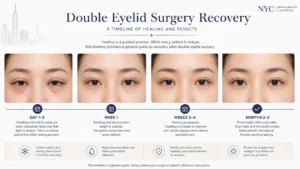
Recovery depends on the technique used and the individual’s healing response.
A general recovery pattern may include:
| Recovery stage | What you may notice |
|---|---|
| First several days | Swelling, bruising, tightness, and mild discomfort |
| Around 1 week | Early swelling begins to improve; follow-up may occur |
| Weeks 2–4 | Eyelid appearance becomes progressively more natural |
| Following months | Residual swelling and scar tissue continue to mature |
Your surgeon’s postoperative instructions should take priority over any general timeline.
Patients should also plan their schedule realistically. Someone working in a client-facing role in NYC may prefer to allow additional time before important meetings, photographs, or social events because visible bruising and swelling can persist after the first week.
What Are the Risks?
Double eyelid surgery is elective surgery, so it is important to understand the potential complications before deciding.
Possible risks include:
- Swelling and bruising
- Temporary irritation or dry-eye symptoms
- Asymmetry
- An overly high or poorly positioned crease
- Scarring
- Changes in eyelid closure
- Ptosis or changes in eyelid position
- Bleeding or infection
- Loss or weakening of the created crease
- Need for revision surgery
The American Academy of Ophthalmology’s EyeWiki materials also describe complications including asymmetry, malposition of the crease, bleeding, lagophthalmos, ptosis, and ocular-surface problems.
That risk discussion is not meant to discourage treatment. It is part of making an informed decision.
Can Double Eyelid Surgery Be Combined With Other Eyelid Procedures?
Sometimes, yes—but combining procedures should be based on anatomy and clinical need rather than adding treatments simply because they are available.
Depending on the patient’s concerns, a surgeon may evaluate whether another procedure is more appropriate or whether an additional procedure could safely be performed at the same time.
For example, someone who believes they have a monolid may actually have significant eyelid ptosis or excess skin. Creating a crease alone would not necessarily address the underlying problem.
This is why an accurate diagnosis comes before selecting a cosmetic technique.
Double Eyelid Surgery Cost in NYC
There is no single price for double eyelid surgery in New York City.
The final cost can depend on:
- Surgical technique
- Complexity of the eyelid anatomy
- Whether additional eyelid procedures are needed
- Surgeon and facility fees
- Anesthesia or sedation
- Follow-up care
Published New York eyelid-surgery pricing varies substantially, and comparing prices is only meaningful when the procedures being compared include the same services and level of complexity.
For this reason, it is better to receive an individualized quote after an examination rather than relying on a generic online number.
How to Choose a Double Eyelid Surgery Provider in Flushing, Queens
When searching for double eyelid surgery in Flushing or elsewhere in NYC, convenience should not be the only consideration.
Look for a provider who:
- Performs a detailed eyelid assessment
- Explains the difference between available techniques
- Discusses your desired crease rather than imposing a standard shape
- Reviews potential risks and limitations
- Evaluates eye health when appropriate
- Shows relevant before-and-after examples
- Gives you realistic expectations about recovery
- Takes time to answer questions before surgery
At ClearLee Perfect Aesthetics, the practice lists double eyelid surgery among its eye-lift services and describes consultation and individualized treatment planning as part of its approach.
For patients in Flushing, Queens, a consultation is an opportunity to discuss whether the concern is actually a monolid, a low crease, asymmetry, hooding, ptosis, or another eyelid characteristic—and whether double eyelid surgery is the appropriate solution.
Double Eyelid Surgery vs Non-Surgical Options
Some people try eyelid tape or adhesive products before considering surgery.
These products can temporarily create the appearance of a crease, but they do not permanently alter the underlying eyelid anatomy.
Frequent or prolonged use can also create problems with complete blinking and ocular comfort in some users. EyeWiki notes concerns including increased tear evaporation and ocular-surface changes associated with eyelid tape use.
For occasional cosmetic use, some people may find temporary products useful. They should not, however, be viewed as equivalent to a surgical procedure.
Questions to Ask During Your Consultation
Before scheduling surgery, consider asking:
- Which eyelid crease style would suit my anatomy?
- Do I have a true monolid, a low crease, or another eyelid configuration?
- Would an incisional or non-incisional approach be more appropriate for me?
- Do I have any signs of ptosis or eyelid asymmetry?
- Could the procedure affect dry-eye symptoms or eyelid closure?
- How much swelling and bruising should I realistically expect?
- When can I return to work and exercise?
- What happens if the two eyelids heal differently?
- What are the risks of revision?
- What will my total treatment cost include?
These questions help shift the conversation from simply asking, “Can I get double eyelids?” to understanding whether the procedure is appropriate and what result is realistically achievable.
Frequently Asked Questions
Is a monolid the same as a single eyelid?
In everyday cosmetic terminology, the terms are often used to describe an upper eyelid without a clearly visible crease. However, eyelid anatomy exists on a spectrum, and some people have a low or partially hidden crease rather than a completely absent one.
What is the difference between double eyelid and single eyelid?
A double eyelid generally has a visible upper eyelid crease, while a single eyelid usually does not have a clearly visible crease. Neither is medically superior to the other.
Is double eyelid surgery permanent?
An incisional crease can be long-lasting, but no surgical result is completely protected from natural aging or changes in tissue. Non-incisional techniques may have a greater chance of crease weakening or recurrence in some patients.
Can double eyelid surgery look natural?
Yes, but the definition of a natural result varies by person. The crease should be planned around individual eyelid anatomy, facial proportions, and the patient’s goals rather than using the same crease design for everyone.
How long does double eyelid surgery recovery take?
Visible swelling and bruising generally improve during the first several weeks, but the eyelid can continue to refine for months. Your actual recovery depends on the technique and your individual healing response.
Is double eyelid surgery available in Flushing, Queens?
ClearLee Perfect Aesthetics lists double eyelid surgery among its eye-lift services in its aesthetic treatment information. A consultation can determine whether the procedure is appropriate for your particular eyelid anatomy and goals.
Does double eyelid surgery change your identity or ethnicity?
The purpose of the procedure should not be to erase someone’s ethnic characteristics. Modern eyelid planning can focus on creating a crease that works with the individual’s existing anatomy and aesthetic preferences.
A Thoughtful Approach to Double Eyelid Surgery
The most important distinction between a double eyelid, monolid, and single eyelid is simply the presence and appearance of the upper eyelid crease. None of these natural variations is inherently a problem.
Double eyelid surgery can be an option for someone who wants to create or refine that crease, but the best result comes from individualized planning. The technique, crease position, and extent of treatment should reflect the patient’s anatomy rather than a one-size-fits-all idea of what an eyelid should look like.
If you are considering double eyelid surgery in Flushing, Queens, NYC, the next step is a detailed consultation with a qualified medical professional who can evaluate your eyelids, discuss your goals, explain the available options, and help you understand both the potential benefits and limitations of treatment.